

Take home message
- The impact of heating and maturation, as well as season of production, on the quality of aged cheese is becoming increasingly well understood.
- “Umami” and “kokumi” are concepts from the world of taste perception that explain how fermentation, maturation and raw milk influence flavour.
Making good cheese is a skill
Gouda cheese is made from (raw) milk, rennet and starter culture. The starter culture converts milk sugar into lactic acid (= fermentation), while the rennet causes certain proteins (casein proteins) to coagulate. During the clumping of the protein, the fat globules are enclosed in the protein mass, the curd. By adding water during preparation (washing the curd), part of the milk sugars, minerals and whey proteins are removed from the cheese curd. When the curd is ripe, it is put in cheese vats, pressed until a rind forms, and the 1-day-old cheese is left to rest and cool. The cheese is then placed in a brine bath (salt bath), which allows salt to penetrate the cheese and moisture (mainly water) to escape. The cheese is then matured on cheese shelfs in a climate-controlled warehouse. Depending on its size, the cheese remains here for a shorter or longer period of time.
The highest level of cheese-making involves raw milk, long-matured cheeses, such as mature Gouda, Comté or Parmesan. These cheeses must not have any flavour defects, should not produce too much unwanted gas or dry out too quickly. If an old cheese reaches the 2-year maturing stage without any problems, it can easily remain on the shelf for up to 5 years, provided the humidity and temperature are right. A characteristic of mature cheeses is their weight, often exceeding 20-25 kg, and up to 50 kg per wheel. The height/width ratio of the cheese, together with its weight, determines how long a cheese can mature, during which time it slowly loses weight. During maturation, changes take place in the cheese due to the breakdown of proteins into peptides, amino acids and flavourings. Old, mature cheese is characterised by its flavour profile and the small crystals in the cheese.
Highland cheese and lowland cheese
There is another fundamental difference between mountain cheese or hard cheese on the one hand and lowland cheese or semi-hard cheese on the other. The differences arise from the starter cultures used, the final temperature (whether or not the curd is “burned”) and the type of vat (stainless steel or copper). Gouda and Cheddar are examples of lowland cheeses. The cheese is made with mesophilic lactic acid bacteria (Lactococcus lactis, Leuconostoc) and the highest temperature is our body temperature (37 oC). Mountain cheeses and hard cheeses are made in copper vats, using starter cultures that contain thermophilic bacteria (Streptococcus thermophilus) in addition to the mesophilic bacteria. The highest temperature here is around 54-58 °C, which was traditionally achieved in the mountains by heating the single-walled copper cheese vat over an open fire, known as “burning”.
The lowland cheeses are pressed into Gouda or Cheddar shapes and the heaviest cheeses (20-25 kg) are matured the longest and sold as mature or aged cheese. The cheese wheels of the hard cheeses can be much heavier and can therefore mature even longer to develop their flavour.
The maturing time, combined with the weight and type of starter culture, appear to influence the typical characteristics we know from these (very) mature cheeses, namely the development of crystals in the cheese and the typical umami flavour. These characteristics come together particularly in hard or mountain cheeses, but similar properties can also be found in semi-hard lowland cheeses. Well-matured old cheeses made from grass milk produce a dairy product that is unique in terms of taste and mouthfeel. Depending on the region (soil type) and season, but in the Comté region also the place of maturation or storage (the fruitière), unique flavours and aromas develop when eating such cheeses. Making such old, matured cheeses well is therefore a form of art, a high art.
Umami flavour and kokumi sensation
It sounds like Chinese. However, the terms umami and kokumi come from Japanese. We owe umami to its discovery in 1908 by Japanese chemist Ikeda Kikunae (1864-1936), but due to the differences between Eastern and Western food cultures, coupled with the different writing systems, it took a long time for “umami” to gain acceptance and recognition in the West. Umami is linked to fermentation and maturation, giving food a savoury, intense flavour that is often perceived as “animalistic”. Umami is known from soy sauce (tamari), but also from certain mushrooms (Shitaki). The first umami was distilled as a substance from seaweed (kelp). Ikeda Kikunae discovered that the substance sodium glutamate from seaweed was linked to the experience of the umami taste. Umami is now recognised as the fifth taste alongside the four familiar ones: sweet, sour, salty and bitter. There are specific taste buds on our tongue for all five tastes. In addition to glutamate, several other chemical substances have been discovered that lead to the taste sensation of umami. Glutamate is the sodium salt of the non-essential amino acid glutamic acid (C5H9NO4).
During fermentation, but especially during the maturation of cheese, this glutamate and its further breakdown products are formed. Proteases and peptidases are enzymes in milk and lactic acid bacteria that break down casein proteins into peptides, oligopeptides and amino acids. These can be further converted into flavourings that contribute to the salty, sweet, bitter or umami taste of food. The Japanese Umami database includes glutamate values from cheese. Figure 1 shows the glutamate concentrations in semi-hard Gouda and Cheddar cheese in relation to the maturing time (https://de.umamiinfo.com/richfood/foodstuff/cheese.html).

Fig 1. The influence of maturation (in months) on the Umami taste perception, measured as glutamate concentration in two types of semi-hard cheeses. Data from the Umami database.
In addition to the taste described as “umami”, which is linked to certain taste buds on the tongue, there is also “kokumi”. Kokumi is produced by further conversion of glutamate into specific di- and tri-peptides. Kokumi should be seen more as an enhancer of glutamate, a flavour booster. These are small peptides composed of 2 or 3 amino acids, one of which is glutamic acid or glutamate. The kokumi sensation is the thick, mouth-filling, lingering taste that is typically produced by fermentation, or after maturation. Kokumi is related to the full and long-lasting experience of taste (taste continuity). The taste remains “in your mouth”, as it were (overall taste experience). There is a whole range of glutamic acid-based “kokumi” peptides, and researchers are now able to measure various glutamyl dipeptides in cheese. The most important ones for assessing maturation in cheese are the gamma-glutamyl dipeptides (Braitmaier et al., 2025). These also increase during the maturation of semi-hard and hard cheeses (see Fig. 2).

Fig. 2. Kokumi: concentration of gamma-glutamyl peptides in cheese made from milk (cow, sheep, goat, buffalo) in relation to maturation (in months); blue-veined and white-mould cheeses are omitted (data obtained from supplemental table 6 of Frölich et al., 2025); Y-axis is a log10 scale).
Incidentally, the moulds used in white mould or blue mould cheeses appear to form extremely high levels of these dipeptides. Here, it is not so much the maturation time that plays a role, as is the case with mature Gouda, Parmesan or Comté cheese, but rather blue moulds (Roquefort) in particular that cause the conversion to gamma dipeptides in a short period of time.
Cheese made from raw or heated milk
The kokumi process in cheese, i.e. the formation of glutamyl dipeptides, is slow, mainly because the enzyme that forms this peptide is heat-sensitive and loses much of its effectiveness through pasteurisation. Unlike raw milk, pasteurised cheese milk has virtually no active glutamyltransferase enzyme (GGT enzyme) left. As a result, the maturation of factory-made Gouda cheese (from pasteurised milk) ultimately produces a poorer flavour profile than the maturation of farmhouse Gouda cheese (from raw milk). Umami and kokumi are characteristic of traditional long-matured cheeses made from raw milk. Pasteurisation reduces the activity of the GGT enzyme by 80%, and in cheese made from pasteurised milk, GGT activity is very low or even non-existent (Braitmaier et al., 2025). Other enzymes are also heat-sensitive, such as lipase, which also plays a role in the maturation and flavour of cheese. The end result is a difference in flavour between mature cheese made from raw milk and mature cheese made from pasteurised milk. The result after maturation is different.
If you then look at the fatty acid composition of the cheese milk, which is influenced by the season (grass fed cows in summer or stable feed in winter) and the cows’ supplementary feed (silage maize and concentrates have a negative effect), you can make the best matured cheese when the cows mainly eat pasture grass in the summer and use the milk to make farmhouse cheese. Traditionally, matured cheese was made in the summer (grass intake) and especially in the month of September. In that month, the fat-protein ratio of the milk was very favourable and the cheese curd remained very supple, even when it was matured over two years. Such grass based cheeses developed a “gamey, meaty” flavour due to the breakdown of glutamate, which we now refer to as umami and kokumi. Crystals in matured cheese are formed by the flocculated amino acids tyrosine and phenylalanine, which also contribute to the mouthfeel. Summer dairy products from grass remain soft and supple, and slices can be cut even after long maturation, mainly due to the higher concentration of polyunsaturated and monounsaturated fatty acids. The typical combination of characteristics is traditionally found in mature Alpine mountain cheeses, French Comté cheeses, Parmesan, but also Dutch Boeren Goudse Oplegkaas (Aged raw milk Gouda). Cheese as cheese should be at its best.
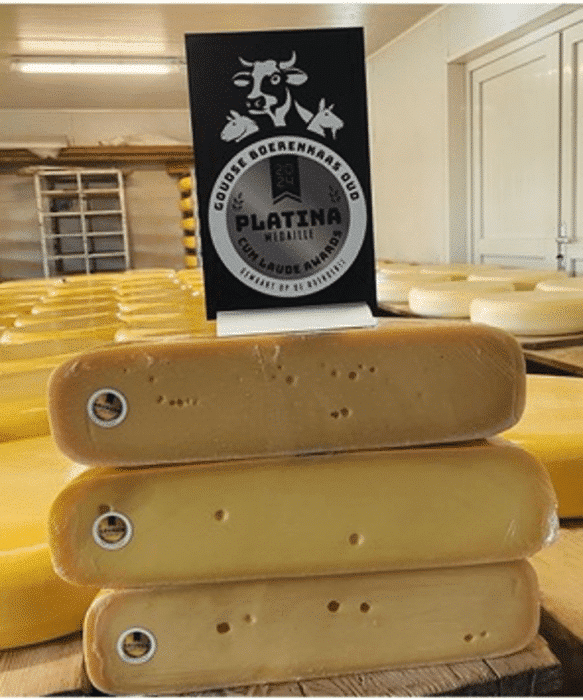
A platinum-awarded Aged Gouda matured cheese from raw milk aged for at least 1.5 years.
A short video about the traditional aged Gouda cheese can be found here.
Literature
- Braitmaier, S. H., Fröhlich, S. M., Somoza, V., Dunkel, A., & Hinrichs, J. (2025). Flavor tuning of semi-hard cheese by targeted formation of γ-glutamyl dipeptides. International Dairy Journal, 166, 106240.
- Fröhlich, S.M., Jünger, M., Mittermeier-Kleßinger, V.K., Dawid, C., Hofmann, T.F., Somoza, V., en Dunkel, A. (2025). Towards prediction of maturation-dependent kokumi taste in cheese by comprehensive high throughput quantitation of glutamyl dipeptides. Food Chem 463, 141130.


