To protect raw milk from spoiling, it is best stored between 2 and 4 oC. This inhibits the growth of mesophilic bacteria that produce lactic acid (Lactobacilli, Enterococci).
It is important, however, that the milk contains virtually no psychrotrophic bacteria (such as Pseudomonas), which secrete lipase and protease and cause the milk to turn rancid.
You can prevent spontaneous hydrolysis of fat and rancidity by choosing fresh milk that has been collected with great care and has a low bacterial count.
Chilling
How cold should you set your fridge to keep your raw milk fresh for a long time? And how can you prevent raw milk from going rancid? These questions also concern the dairy, as they aim to collect milk from the farm only once every three days. One piece of advice regarding the consumption of raw milk is to chill it sufficiently, to between 2–4 oC. A standard fridge is usually too warm, as the temperature rarely drops below 7–8 oC. So what happens to the bacteria present in raw milk? Which bacteria are problematic? What can you, as a consumer and as a farmer, do to maintain high milk quality? What is the difference between storage temperatures of 2, 4 or 8 oC?
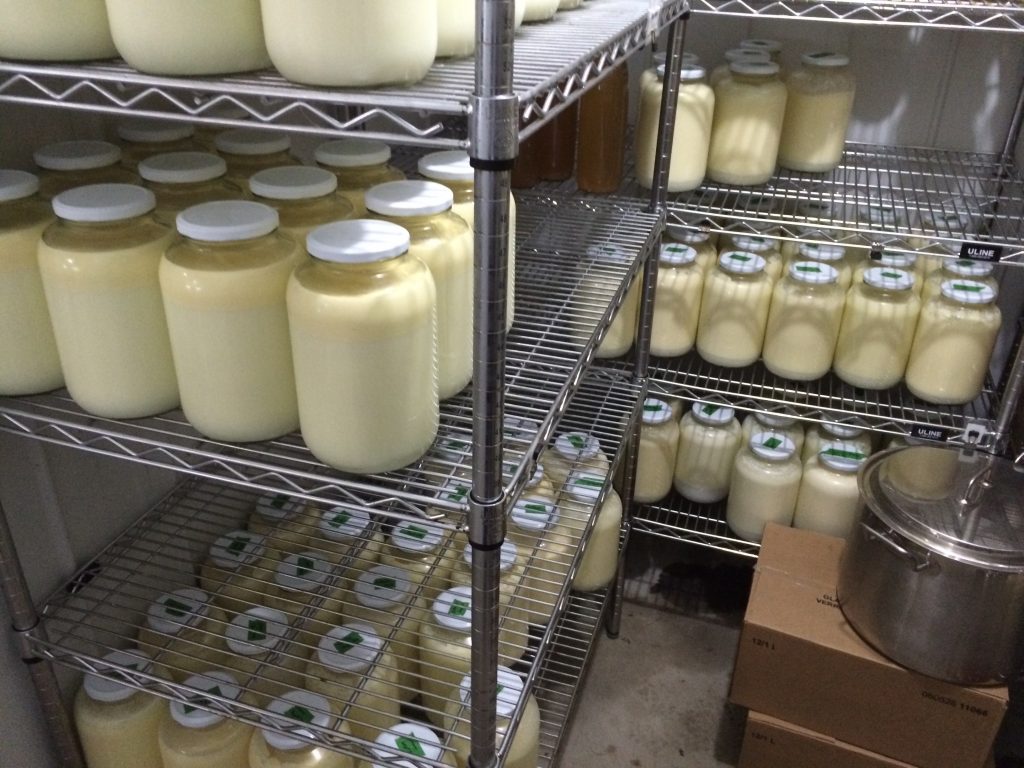
Bottled milk, where the cream layer is clearly visible
Bacteria causing spoilage
Milk is virtually sterile inside the cow’s udder. Bacteria enter raw milk either (1) through mastitis or (2) via ‘dirt’ on the outside of the teat. This ‘dirt’ refers to the bacterial environment in which the cows live and move: their lying areas, the walkways, splashed-up dirt and the ‘dirt’ that is inadvertently swallowed during milking if a milking cluster falls off. The third source of bacteria is the milking equipment: the milking machine (teat liners, hoses, rubber parts, stainless steel), the milk tank, the bulk milk tanker and the storage tanks at the dairy plant.
Back when wooden equipment was still in use (milk buckets, storage and processing vats), people had to hurry to drink or process the milk. The mesophilic bacterial count was so high that, in the absence of refrigeration, it multiplied extremely rapidly and turned the milk into ‘Dickmilch’ or ‘clabber’. We refer to this as spontaneous acidification. Modern biofilms probably look different; (undesirable) bacteria attach themselves in thin layers to stainless steel surfaces or rubber. Biofilms are produced by the bacteria themselves when they secrete sugars (exopolysaccharides) to which they can then attach. Biofilms give the bacteria a better chance of survival. Removing biofilms requires a specific approach using cleaning agents. Biofilms can be dangerous when zoonotic bacteria such as Listeria are hiding within them. Biofilms containing cold-tolerant bacteria, such as Pseudomonas, are particularly notorious. From within the biofilms, Pseudomonascan multiply in raw milk, not by breaking down lactose, but by breaking down fat and protein; in short: undesirable spoilage.
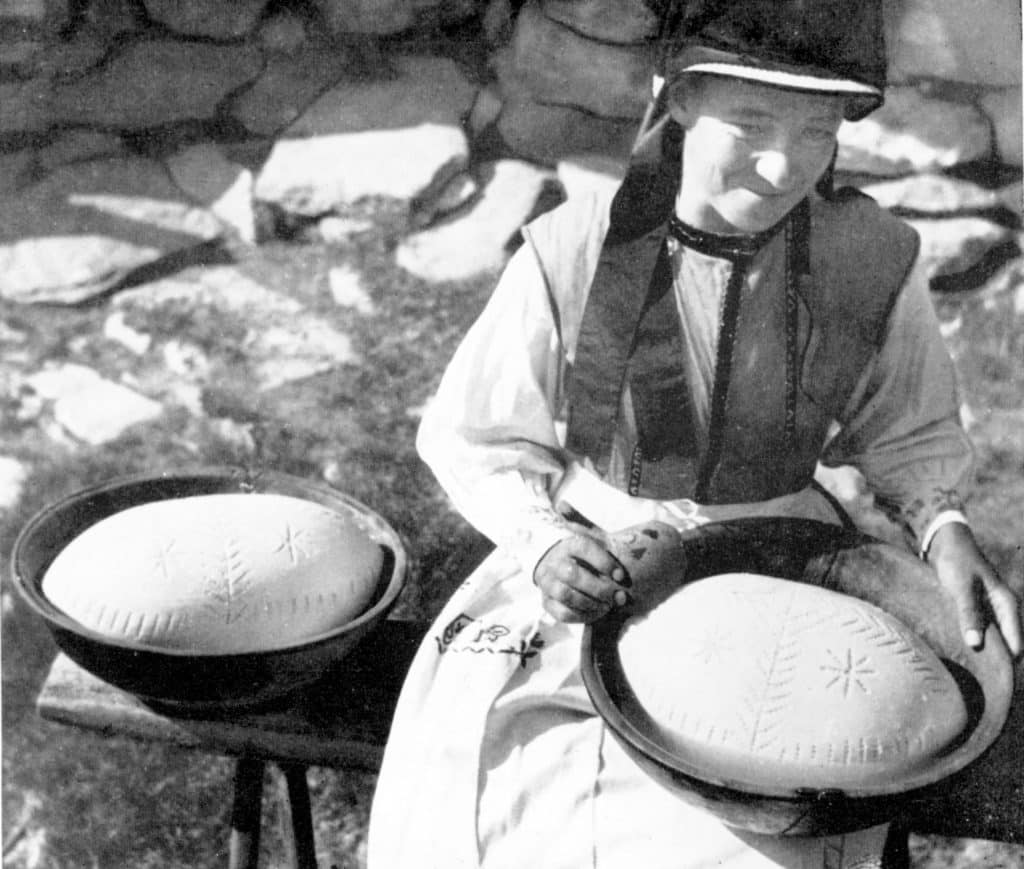
Farm woman in the Lötschen valley (CH) preparing large bowls of raw milk butter (around 1910-1930)
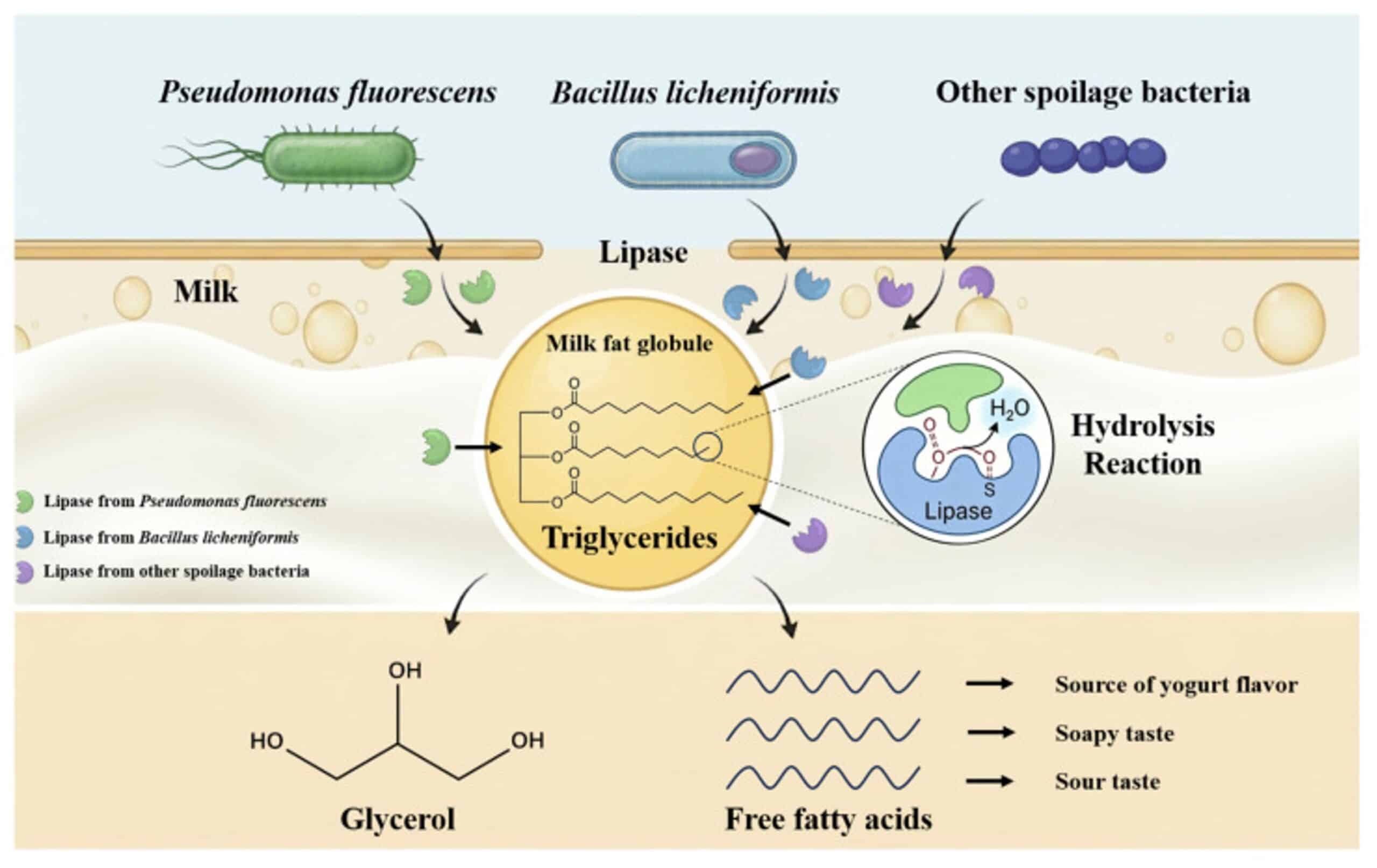
Both bacteria and their enzymes are responsible for spoilage, and this breakdown produces numerous odours and flavours that we do not always appreciate. For example, rancidity is one of the undesirable consequences when milk fat breaks down (De Jonge et al., 2011). Lipases break down milk fat, leading to rancid, soapy and sometimes bitter off-flavours due to the formation of medium-chain fatty acids. The triglyceride is split into glycerol and three fatty acids, known as free fatty acids (Figure 1). The increase in the proportion of free fatty acids in milk is perceived as ‘rancidity’. Rancidity is a matter of getting used to it, and it is likely that people have simply been eating rancid butter for centuries. Quite simply, because they were unable to control the process of undesirable fat breakdown. One gets used to everything, apparently including the consumption of rancid butter. Nowadays, consumers no longer accept such strong (butter) flavours. Fat and butter must be free from rancid off-flavours.
Figure 1. Fat breakdown by the enzyme lipase, which is released into the milk by spoilage bacteria (adapted from Lu et al., 2026)
Chilled, raw camel’s milk as an example
The release of enzymes—including lipase and peptidase—by Pseudomonas decreases as the milk is chilled to lower temperatures. This is evident, amongst other things, from research into raw camel’s milk. Chinese researchers investigated what happens to unheated camel’s milk when this raw milk is stored at 4 oC for six days (He et al., 2026). After milking on day 0, the highest count was for lactic acid bacteria (almost 16,000 cfu/ml). Psychrotrophic bacteria and E. coli are present in much smaller numbers (approximately 1,000 cfu/ml) (Table 1).
Table 1. Results of various measurements on the starting day (day 0 in the figure below). Bacterial values in the 1st column as log10 and in the 2nd column as absolute values (taken from He et al., 2026).
log10
‘normal value’
pH-value
6,8
Lactose
g/100 ml
5,1
Mesophylic count
cfu/ml
3,8
5.600
Lactic acid bacteria
cfu/ml
4,2
15.800
Psychotrophic bacteria
cfu/ml
3,0
1.000
E.coli
cfu/ml
3,0
1.000
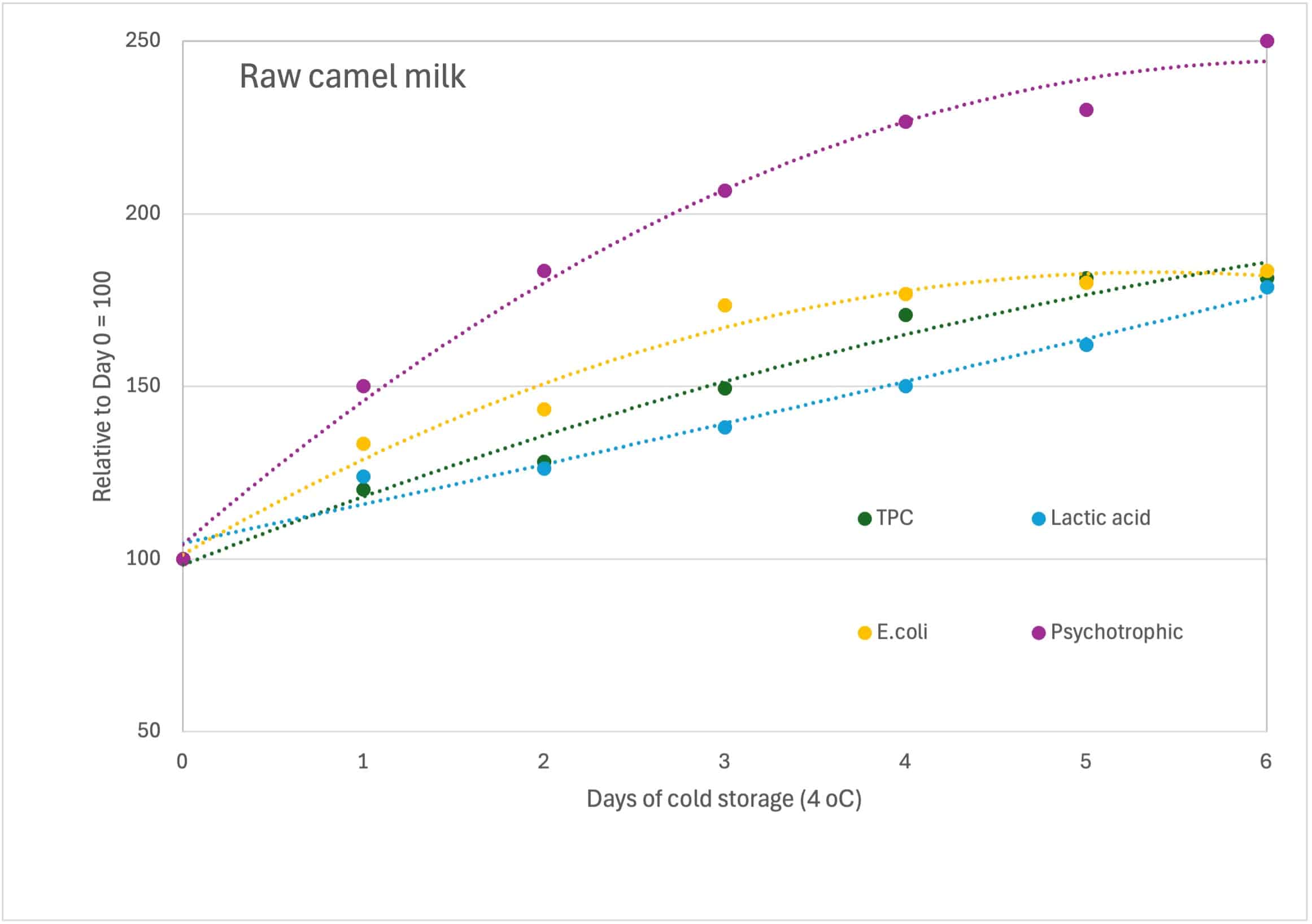
Lactic acid bacteria, E. coli and the total plate count increase at the same rate during cold storage (4 oC). The log10 value rises by around 75 per cent compared with the value on day 0. The increase of cold-tolerant bacteria, however, is more rapid, and the value on day 6 is approximately 2.5 times higher than the initial value. The result is commonly observed, including in cow’s milk that is refrigerated. It is not without reason that these bacteria are called cold-tolerant (= psychrotrophic): they grow faster at 4 oC than other bacteria or bacterial groups, which are much more mesophilic.
Incidentally, the threshold at which milk begins to taste rancid is quite high, at more than log10 = 7. In this raw camel’s milk, this is reached on day 4 (log10 = 6.8)
Figure 1. Increase in bacterial counts expressed as a percentage of the value on day 0 (see Table 1), data derived from He et al., 2026.
Raw milk meant for direct consumption
There are many examples of customers who buy German ‘Vorzugsmilch’ stocking up on the milk just once a week. Officially, there is a best-before date of 96 hours after dispensing (4 days). Experience shows that Vorzugsmilch remains safe to consume for much longer, provided it is kept well chilled. American businesses are regulated differently, and there are raw milk producers there known to assign a much longer shelf life to their milk. Years ago, Hawthorne Valley Farm had a best-before date of around 9 days. Mark McAfee (Raw Farm, California) even claims a best-before date of almost 20 days.
This may sound extreme, but farms that maintain truly high standards of hygiene are able to supply milk with very low bacterial counts, often below 2,000 or 3,000 cfu/ml (approximately log10 = 3.4). When this is combined with rapid cooling of the milk after milking, such low-bacteria milk is comparable to pasteurised milk in terms of shelf life. Everything hinges on a very low bacterial count and the type of bacteria present in the milk.
This is also evident from Italian research into cheese milk (Giagnoni et al., 2026). Initially, a high-quality milk processor was assessed; later, this was compared with an ordinary, run-of-the-mill processor that did not claim to have the very best hygiene (-parameters) (Table 2).
Table 2. Difference in bacterial growth in milk obtained under hygienic conditions (left) and milk with moderate hygiene (right) after 24 hours’ storage at increasing temperatures. Log10 values and percentage of bacterial DNA (from: Giagnoni et al., 2026)
Storage- temp.
Good hygiene
Moderate hygiene
Plate count
Coliform
Pseudomonas
Plate count
Coliform
Pseudomonas
4 oC
4,02
2,30
2,4%
4,98
3,90
92%
7 oC
4,08
2,70
0,0%
5,18
4,40
37%
9 oC
4,10
3,00
0,0%
6,18
4,85
6%
In this example, the bacterial count is less than 12,500 cfu/ml (log 10 = 4.10), if the milk has been collected hygienically. The mesophilic bacterial count increases by only 2% if the milk has been stored for 24 hours at 9 oC instead of 4 oC. This is very different for milk with a high bacterial count, where the increase is 24 per cent. Here, bacteria multiply much more rapidly at a storage temperature of 9 oC. Something similar also applies to a hygiene indicator, namely the number of coliforms.
Under moderate hygiene conditions (Table 2, right), Pseudomonas accounts for a significant proportion of the bacterial DNA (92 per cent). At higher storage temperatures, other bacterial groups (also) begin to proliferate and the proportion of Pseudomonas decreases. Under high hygiene standards (Table 2, left), the proportion of Pseudomonas is small and even negligible if the milk is stored at slightly higher temperatures. Other bacteria then take its place.
In conclusion…
…spoilage caused by Pseudomonas during cold storage is best controlled by maintaining high hygiene standards on the dairy farm. Biofilm formation in the equipment must be prevented. Although the Pseudomonas bacteria are ‘destroyed’ during the pasteurisation of raw milk, by that point they have long since released their digestive enzymes (lipases, proteases) into the milk. These enzymes remain active, even after pasteurisation. If you wish to prevent rancidity in raw and heated milk, you must use milk produced under (very) hygienic conditions, where farmers do their utmost to deliver milk with a very low bacterial count and virtually no Pseudomonas.
Literature
De Jonghe V, Coorevits A, Van Hoorde K, et al. Influence of storage conditions on the growth of Pseudomonas species in refrigerated raw milk. Appl Environ Microbiol. 2011 Jan;77(2):460-70.
Giagnoni L, Deb S, Tondello A, et al. The legacy of raw milk storage temperature is associated with cheese microbiome composition, notwithstanding pasteurization and starter addition. FEMS Microbiol Lett. 2026 Jan 7;373:fnag046.
He J, Xue Y, Ji C et al. Integrated microbiome and metabolomics analysis reveals dynamic changes in raw camel milk during refrigerated storage. Journal of Dairy Science, 2026; 109, 11421-11434
Lu Y, Wu Q, Wang J, et al. Dairy Spoilage Bacteria and Their Lipases: Prevalence Patterns and Molecular Traits. Foods. 2026 Aug 5;15(15):2750.
Excellent review.
Our initial bacteria counts at Raw Farm in California are 0-3 coliforms and SPC of less than 500 and often in the 100 or less range. Chilling is accomplished in 2 minutes down to 2-3C or 36 F with a glycol plate chiller. Super clean dry udders, super clean milking systems, daily testing to assure compliance and catch issues early.
This data is also found at all Raw Milk Institute trained dairies. There are currently 72 Listed internationally. Everyone of those dairies get long delicious shelf life in the 21 day plus range. Problems come from using wrong standards and practices ie… milk for pasteurization!




Excellent review.
Our initial bacteria counts at Raw Farm in California are 0-3 coliforms and SPC of less than 500 and often in the 100 or less range. Chilling is accomplished in 2 minutes down to 2-3C or 36 F with a glycol plate chiller. Super clean dry udders, super clean milking systems, daily testing to assure compliance and catch issues early.
This data is also found at all Raw Milk Institute trained dairies. There are currently 72 Listed internationally. Everyone of those dairies get long delicious shelf life in the 21 day plus range. Problems come from using wrong standards and practices ie… milk for pasteurization!
World peace and whole food nutrition for all !
Mark Mcafee
Fresno CA USA
Raw Farm