
Take home message
It is an age-old contradiction: bacteria or environment, nature or nurture, genetics or epigenetics/nutrition/lifestyle? Where do you start when it comes to controlling infectious diseases? Diseases such as tuberculosis have been brought under control in Western countries over the last 150 years. There is a timeline that begins with the recognition and identification of a bacterium, the improvement of well-being and hygiene, and finally ends with control, eradication, and vaccination. The question is, is there now a reason to combat infectious diseases? But also, what new problems have arisen?
Decline of Tuberculosis
Most consumers no longer experience raw milk consumption. We have been made bacterophobic, drinking pasteurised milk and eating processed products from pasteurised milk. The main impetus to switch to pasteurisation was to (further) curb Tuberculosis (TB) and other infectious diseases in which raw milk had a role. In 1882, German physician Robert Koch (1843-1910) discovered the bacteria as causative agents of disease. A further reason for pasteurisation was a longer shelf life, which was an advantage in times of inadequate refrigeration and slow transport. However, when you look for the role of pasteurisation (heating) in the eventual reduction of TB, it turns out that the decline of TB started as early as the mid-19th century, i.e. well before all milk was pasteurised and the bacteria got its name: the Tubercle bacteria (Mycobacterium tuberculosis). Important champions of curbing the germs, the bacteria or germs were Louis Pasteur (Fr) and Robert Koch (D).
Environment versus bacterium
An interesting counter to the focus on the ‘germ’ was the English physician Thomas McKeown (1912-1988). McKeown did not oppose against understanding bacteria, but he valued bacteria in a different way. McKeown was a professor of social aspects of medicine and therefore a medical historian with knowledge of 19 and 20th century England and Wales. Thomas McKeown was clearly on the side of the ‘environment’ when it came to interpreting mortality rates, infant mortality, growing old, etc. His theory was particularly concerned with the role of welfare, increasing financial spending power, which he believed played a role in the declining problem of infectious diseases. Tuberculosis was only one of the possible infectious diseases, children and people could further suffer and/or die from smallpox, typhoid, pneumonia, scarlet fever, cholera, diphtheria, polio, meningitis, whooping cough or measles. It was the era, when infectious diseases determined lifespan and even before Fleming had found his antibiotics (Penicillin). Especially during summer, bacterial pressure was high (heat) and there could be persistent diarrhoea, dehydrating a child. Of course, one of the most important discoveries is a bacterium (and in parallel the viruses), found to be linked to a particular disease, the work of Pasteur and Koch. An equally important insight is needed, namely why certain bacteria can develop, the insight of, among others, the French physiologist and zoologist Claude Bernard (1813-1878). Bernard’s most famous quote after 40 years of research: ‘the germ is nothing, the environment is everything’. McKeown and Bernard are therefore on the same train of thought: how can the environment give an organism place to grow? In terms of disease control, the questions are: should we focus on curbing germs (control and eradication), should we inhibit transmission from organism to organism (isolation, shielding) or on making the environment healthy, where a germ may remain present but can no longer develop explosively?
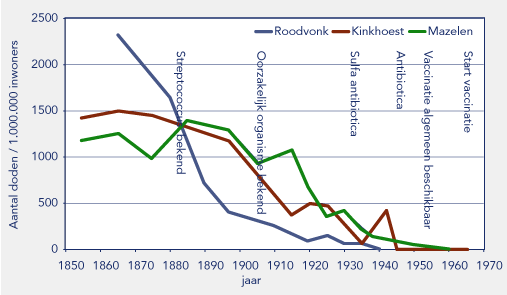
Figure 1. The decline in the number of deaths per 1,000,000 children in 10-year periods from 1850 to 1970 (scarlet fever (roodvonk), whooping cough (kinkhoest) and measles (mazelen)). In the process, when: bacteria were identified, the development of medication, antibiotics and vaccination (From: McKeown, 1979).
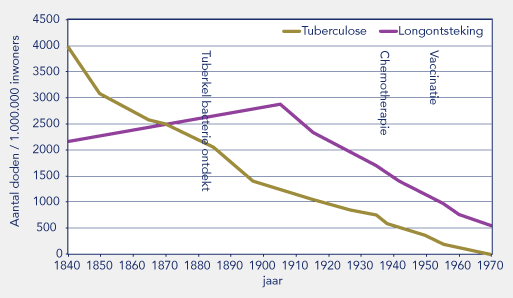
Figure 2. The decline in the number of deaths per 1,000,000 children in 10-year periods from 1850 to 1970 (Tuberculosis and pneumonia (=longontsteking)). In the process, when: bacteria were identified, the development of medication and vaccination (From: McKeown, 1979).
McKeown (1979) shows in several publications, that the decline of the infectious diseases already started long before antibiotics were developed or vaccination was introduced (see both figures). What he found in England and Wales probably applies to the entire Western world: America and Europe. In the Netherlands, the National Vaccination Programme came into force in 1957 against four diseases, namely diphtheria, whooping cough, tetanus and polio. McKeown attributes the sharp decline in mortality prior to vaccinations and actual medications to the step-by-step change in our living environment and therefore the environment of the bacteria, which accompanied us. Here you can think of a better housing, ventilation, personal hygiene, there came good reliable drinking water, separation of wastewater and drinking water and the development of canalisation in cities (Wray, 2015; McCleary, 1904; Lowe and McKeown, 1954). Horses gradually disappeared from cities and were replaced by cars. Despite, considering the car a huge air pollutant in inner cities, the pressure from flies and horse droppings decreased enormously. In New York, streets were paved, a better system was developed to collect and dispose of waste from the city, open areas (parks) were created in the city and housing improved. These are all measures that promote general hygiene. Yet the risk remains high in summer due to lack of cooling facilities. There are big differences in diarrhoea between summer and winter mortality among infants.
Unsafe raw milk
Also so-called Swill milk was already banned in 1861 (Obladen, 2014). This was milk extracted from mostly sick ‘city cows’, that lived off brewery waste instead of roughage. The cows were kept in dark, dirty barns and were filthy and sick. Many of these cows were there to provide children living in towns with (raw) milk.
Shortly before the turn of the 20th century, an awareness emerged, that there were several factors affecting public health and infant mortality. Around providing milk to infants, there were clearly two possibilities, either a heated or as raw milk. Proponents of pasteurisation of cow’s milk, including American philanthropist (and businessman) Nathan Straus had set a goal of no raw milk being offered in US cities within a few years. All milk for young children had to be pasteurised, or sterilised (heated for 10-30 minutes at 100o C in some cities). In 1893, the first New York shop opened offering only heated milk for infants, following the example of the French ‘la Goutte de Lait’, which provided sterilised milk for infants in several French cities (McCleary, 1904). In 1903, 4% of the milk in New York was pasteurised, in 1918 almost all of it (98%), and there are similar developments for the other cities (Brand, 1925). McCleary (1904), however, describes what measures were taken in parallel by the New York city government. Besides improving the urban environment, counselling by nuns or hygiene inspectors (a precursor of the consulting agencies) came in, checks were made to see if the baby was developing well in terms of weight. That infant mortality was high is clear from the lack of knowledge and understanding, especially among the poorest of the poor. McCleary (1904) describes, that people fed infants the same as adults: hard-boiled eggs, cheese, carrots, beer and even spirits. The slightly more educated gave their children a choice of one of the milks: cow’s milk whether heated and adjusted or not, condensed, sweetened milk or, of course, breast milk. For Paris, Obladen (2012) indicates, among infants, 46% mortality was present, if they were not fed with mother’s own breast milk compared to only 5% among breastfed children. Even then, breastfeeding was rated high.
Safe raw milk
Although Straus ‘claims’ (Obladen, 2014), that his action of providing only heated milk to infants reduced infant mortality and infection with TB, this does not match the figures. TB often affected the weaker in the population, who lived in the most unhygienic conditions and were poorly nourished. The urban pollutants and the gradual improvement in hygiene are also environmental factors determinating the infection rate of TB, so-called co-factors. Straus was a clear representative of the ‘germ’ theory. Avenues other than killing bacteria were also sought and found. Denmark was home to the Copenhagen Milk Supply Company in 1879, which developed a system to deliver raw rather than heated milk for infants, as they recognised the added value of raw over heated milk (Atkins, 2010). This involved adjusting the conditions, how the milk was extracted, cow health monitoring (TB), filtering and refrigeration of the milk and sealed, refrigerated transport into the city. Such milk-delivery schemes also emerged around the city of Hamburg (Germany) for example. The focus was not on killing the bacteria but maintaining a health and hygiene status of cow and farm to deliver safe raw milk (Atkins, 2010). It is a precursor to the later, legal Vorzugsmilch (www.milch-und-mehr.de), so-called Grade-A raw milk. Up till the 1960s, in a city like Bremen (Germany), there were more than 15 dairy farms supplying Vorzugsmilch delivering raw milk to private houses, elderly homes and Kindergarten. The control of such infant milk programmes was often in the hands of medics, who oversaw hygiene (cows, barns, people), refrigeration and bacteriological security.
Meaning of raw milk nowadays
Nowadays, more than a century after the discovery of bacteria, we are facing a global increase in asthma, allergies, hay fever and many other ‘non communicable diseases’, conditions you cannot get through infections from a sick person. We get them through epigenetics, through the environment, through our changed life habits. This is where the cultural heredity comes in by copying behaviour, eating patterns and lifestyles from Western society. This epidemic is linked, among other things, to the unavailability of raw milk for young children and pregnant mothers. It is becoming increasingly clear, that we need bacteria for a healthy immune response, where the body responds only to foreign bacterial and viral invaders, not to our food. Raw and raw-fermented products offer part of the solution, it is becoming increasingly clear from epidemiological and experimental research (Loss et al, 2011; Braun-Fahrländer et al, 2010; Abbring et al, 2019).
Literature
- Abbring, S., Kusche, D., Roos, T. C., Diks, M. A., Hols, G., Garssen, J., Baars, T., & van Esch, B. C. (2019). Milk processing increases the allergenicity of cow’s milk—Preclinical evidence supported by a human proof‐of‐concept provocation pilot. Clinical & Experimental Allergy, 49(7), 1013-1025.
- Atkins, PJ (2010) Liquid Materialities: a History of Milk, Science and the Law Farnham: Ashgate, 334pp.
- Brand, H. (1925). Kritische und experimentelle Studien zur Pasteurisierung der Milch:(Kuhmilch und Frauenmilch) (Doctoral dissertation, ETH Zurich).
- Braun‐Fahrländer, C., & Von Mutius, E. (2011). Can farm milk consumption prevent allergic diseases?. Clinical & Experimental Allergy, 41(1), 29-35.
- Loss, G., Apprich, S., Waser, M., Kneifel, W., Genuneit, J., Büchele, G., … & Gabriela Study Group. (2011). The protective effect of farm milk consumption on childhood asthma and atopy: the GABRIELA study. Journal of Allergy and Clinical Immunology, 128(4), 766-773.
- Lowe, C. R., & McKeown, T. (1954). Incidence of infectious disease in the first three years of life, related to social circumstances. British Journal of Preventive & Social Medicine, 8(1), 24.
- McCleary, G. F. (1904). The Infants’ milk depot: its history and function. Epidemiology & Infection, 4(3), 329-368.
- McKeown, T. (1979; 2014). The role of medicine: dream, mirage, or nemesis?. Princeton University Press.
- Obladen, M. (2012). Bad milk, part 1: antique doctrines that impeded breastfeeding. Acta paediatrica, 101(11).
- Obladen, M. (2014). From swill milk to certified milk: progress in cow’s milk quality in the 19th century. Annals of Nutrition and Metabolism, 64(1), 80-87.
Foto: koeien drinken uit een uitgeholde stam als drinkbak, Zillis (CH)


