
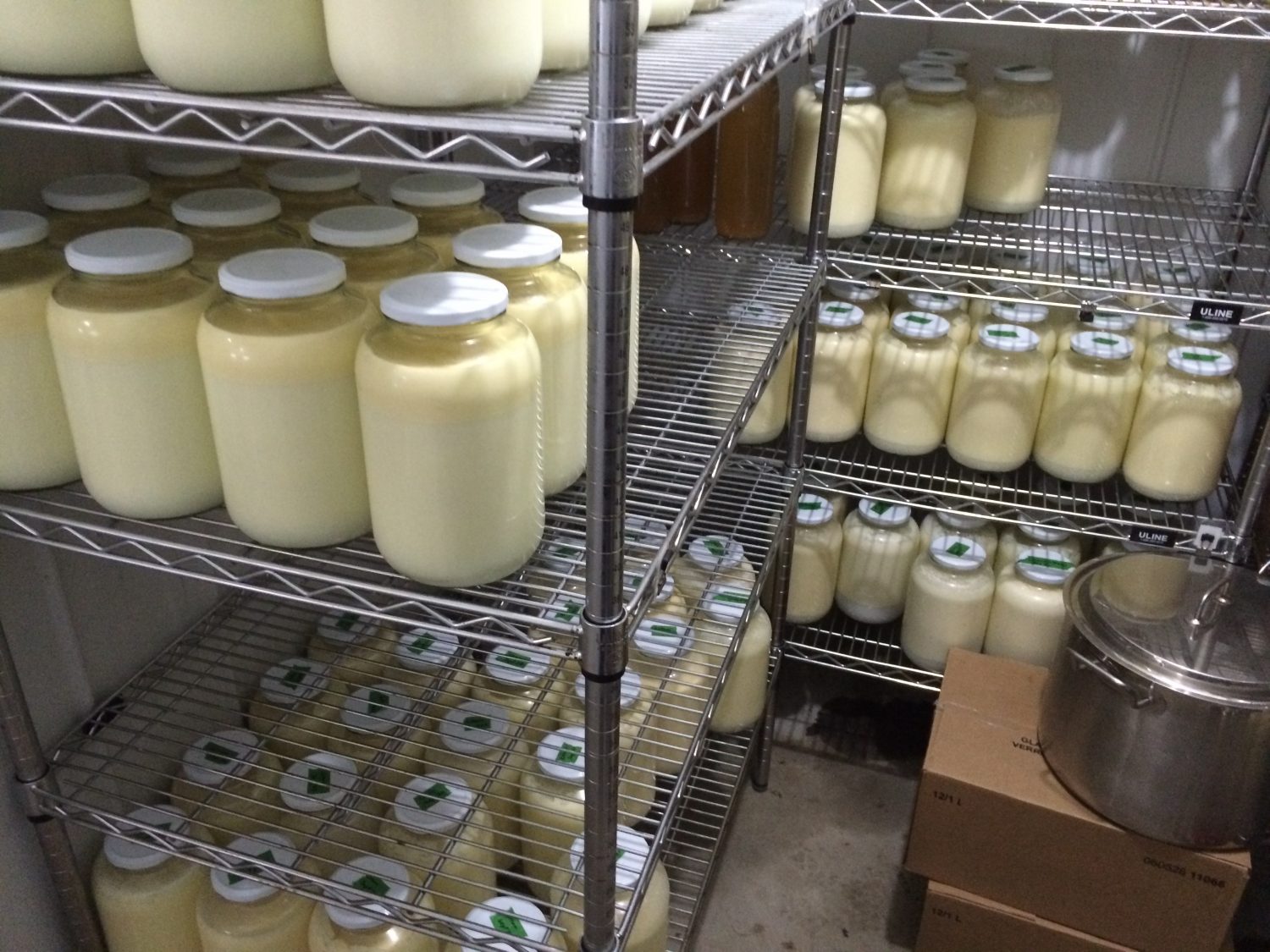
Vorzugsmilch, RIP
Vorzugsmilch, or raw milk suitable for young children, the milk that healed, milk that was used for milk cures, milk that was recommended by doctors, was first mentioned around 1900 and resulted in legislation (Vorzugsmilchgesetz) around 1930. In 1960, there were more than 10 Vorzugsmilch dairy farms in the city-state of Bremen alone, distributing milk in Bremen from the outskirts of the city: delivery to families’ doorsteps, to nurseries and to homes for the elderly. However, our own inventory about 10 years ago revealed only 11 Vorzugsmilch farms left, but now for the whole of Germany. They delivered no more than 1 million litres of raw milk annually. In February 2026, we counted three Vorzugsmilch dairies. Almost all dairy farmers have given up on producing Vorzugsmilch.

There have been many developments in terms of regulations and the technical capabilities to detect every bacterium. Every discovery, but especially every outbreak anywhere in the world, involving any raw milk, has led to stricter regulations, warnings and increased fear surrounding the consumption of raw milk. Due to the pertinent refusal of control authorities (often the local veterinary services) to grant licences to new companies, raw milk consumption has now slowly died a quiet death in Germany too. And this despite the fact that there has hardly ever been a problem or outbreak caused by Vorzugsmilch consumption.
Raw milk as a “whole food” is undesirable, too elusive. People are much more interested in looking for properties in raw milk that may offer protection against asthma and allergies. The cow barn pill based on isolated beta-lactoglobulin is an example of this and is abundant in raw milk and cow urine. We have ended up in a malleable, technical, controllable world in which we apparently “know” how life functions, as determined by science. There is now only one possible narrative, that of the government and natural science. They have “decided” to communicate that raw milk is particularly dangerous.
How differently people viewed milk consumption at the beginning of raw milk control is evident from an article in the Nederlands Weekblad voor Zuivelbereiding en Veeteelt (Dutch Weekly Journal for Dairy Production and Livestock Farming), No. 15, 18th year, 9 July 1912, entitled: “Winning en beoordeeling van hygiënisch goede melk” (Production and assessment of hygienically good milk). The text of the article is reproduced below verbatim, with the woolly and formal old Dutch language rewritten. Some irrelevant passages have been omitted from the original text.
Nederlands Weekblad Zuivelbereiding en Veeteelt, (1912) describes:
Dr O. Rammstedt from Dresden presents a scientific analysis in the Chemische Zeitung Cöthen of milk that is suitable for infant nutrition and high-quality consumption milk. He discusses the optimal design of the cowshed and methods for testing the quality of pure milk.
According to Rammstedt, recent insights show that the best milk retains its natural composition if it is uncooked, unsterilised and unpasteurised, and free from additives. This implies that milk must come from healthy cows that are milked under strictly aseptic conditions. As an example, Rammstedt cites the model farm on the “Bienert” estate in Dresden-Racknitz. Here, the cattle are regularly checked by a veterinarian and, to prevent the transmission of tuberculosis (TB), each animal is only milked during one lactation period. These measures, combined with meticulous care, are an effective approach preventing the spread of TB. It is also essential that dairy farmers recognise the importance of a healthy and robust herd.
Careful selection and care of cows for raw children’s milk is very important, as are well-designed cow barn hygiene and barn design. Rammstedt describes the Racknitzer cowshed, a tied barn. It features a flat, waterproof floor, tiled corridors, resting areas with coconut mats sprinkled with sawdust, and immediate removal of faeces via an underground channel and discharge chain. Extraction systems, water misting, and feeding moistened, dust-free roughage minimise the transmission of bacteria.
Municipal tap water, which flows automatically into covered drinking troughs, contributes to optimal barn hygiene. The cleanliness of the cows also receives a great deal of attention. They are brushed daily and washed weekly, with regular shearing of the animals facilitating the work. The milking equipment is carefully cleaned and sterilised. All milk ends up in the milk can via a milk filter to prevent contamination. This is in line with the principle of “prevention is better than cure”. That is why the flanks of the cows are also wiped with a damp cloth. The milking staff work hygienically and are dressed in white work clothes and headgear.
The first few jets of milk are discarded, as they may contain harmful micro-organisms. The “Milch Merkblatt” (Milk Information Sheet) drawn up by the Imperial Health Service states that the milker must examine the first jets from each teat, collect them separately if necessary and then discard them. After boiling, this milk can be fed to animals.
For hygienic storage of raw milk, it is recommended that the milk be cooled to approximately 4°C immediately after milking, which is essential to maintain quality. During transport, the milk must remain cooled, for example by using cooled bottles wrapped in cardboard. It goes without saying that milk traded under these strict hygienic conditions must have a higher price than milk that does not fully comply with these standards.
Food inspections focus primarily on detecting adulteration and determining visible contamination, with the contamination level providing information mainly about the amount of undissolved cow manure in milk. H. Luhrig states that complaints about the purity of milk are frequent and that without coercive measures due to negligence in the hygienic production of milk, recommendations for improvement will have little effect. No other foodstuff accepts minute particles of manure, whereas milk does. On the other hand, there is a critical attitude towards preservatives, the adverse effects of which have hardly been demonstrated, but the marketing of contaminated milk is given less attention. The control of raw milk that is marketed is mainly of a chemical nature. However, additives such as water or the removal of fat do affect nutritional value, but not health.
Improvements in quality must therefore start primarily on the farm. Cooperation between government, consumers, producers and transporters is necessary to guarantee the quality of raw milk. Railway companies should promote efficient procedures for loading, transhipment, transport and cooling of milk, while traders and consumers are responsible for careful handling of the end product.
Simple, but effective milk testing in 1912
Rammstedt’s vision is that milk should be produced and handled in such a way that it can also be consumed raw, but he acknowledges that in certain situations, sterilised, boiled or pasteurised milk should be preferred. However, he recommends only choosing heated milk that is also potentially safe to drink in its raw form. It is therefore always important to carry out tests to assess the hygienic status of raw milk. Various test methods such as the boiling test, alcohol test, acid titration, leukocyte test, fermentation test, catalase test, reductase test and dirt content determination are mentioned as tools for monitoring milk quality. The presence of leukocytes and streptococci in milk is also highlighted in cases of chronic mastitis.
The usefulness of this approach is confirmed by experts, who attribute a significant proportion of infant mortality to the presence of streptococci in milk. Fermentation tests, such as the milk fermentation and rennet fermentation tests, also provide valuable insights into the suitability of milk for direct consumption. These tests assess how quickly microorganisms can develop. When milk is stored at 40°C for twelve hours, infant milk should not curdle, smell stale or show any gas development. After 24 hours, “good” raw milk should only show lactic acid fermentation. Any deviation means that the milk is unsuitable for baby food, among other things.
The rennet test follows the same principle and is performed using the same device. After adding a specific amount of rennet, the quality of the curdled casein is assessed after twelve hours: it should form firm, straight cheeses without gas formation. With some experience, one can learn to determine the ratio between milk and rennet, as well as the effect of fermentation germs present on cheese substance and milk sugar.
During the catalase test, the amount of gas formation is determined when milk is mixed with hydrogen peroxide. Milk usually contains only small amounts of the enzyme catalase, which breaks down hydrogen peroxide into oxygen and water. Milk with a high catalase content – for example, due to bacterial contamination, mastitis or colostrum – produces much more gas. Another control measure uses dyes: milk rich in bacteria discolours methylene blue more quickly than milk with few germs. In Sweden and Denmark, this reductase test is already used to assess raw milk that has been placed on the market. The various methods make it possible to properly control the quality of milk. Essential to this is cooperation between producers, doctors, veterinarians, government, users and traders, so that safer milk and thus better public health can be ensured.
Facit
The article from 1912 is recognisable and the instructions for producing good, safe raw milk have not changed much. However, a lot has changed between the early 1900s and 2025. In particular, the scale of farms and the number of cows per farm has changed enormously. Time has become a scarce factor in milking. We have moved from tied barns to loose housing, from open bucket systems to fully closed milking systems with pipes. Soda, citric acid and hot water have been replaced by composite cleaning agents. There are still dairy farmers who are able to meet the requirements imposed on them by the Vorzugsmilch legislation. However, what farmers are struggling with is being able to detect every bacterium in milk without any clarity as to whether “every bacterium” will also lead to a health problem. Which standard actually provides safety and for whom? Due to changes in society that favour certainty and highlight every bacterial finding as a danger, fewer and fewer consumers still have a “healthy” relationship with livestock farming, cows, stables and raw milk. In the meanwhile, Vorzugsmilch has died a quiet death.
Literature
The text was written by: H.M. Kroon, lecturer at the National Veterinary School in Utrecht, and D. Schurink, National Veterinary Surgeon in Hummelo and Keppel. The text can be read in its entirety via Delphet Tijdschriften Historie (online) in: Nederlands Weekblad voor Zuivelbereiding en Veeteelt (Dutch Weekly Magazine for Dairy Production and Livestock Farming), No. 15, 18th year, 9 July 1912.


