

… provided it is mainly consumed in full-fat cheese.
Take home message
- Milk fat has once again been shown to have a protective effect against lifestyle diseases, in this case Alzheimer’s and dementia.
- The effect depends on the food matrix in which the milk fat is found. Full-fat cheese and cream are beneficial.
Dementia as a spectre for the ageing population
In the fight against lifestyle diseases, dementia is a high priority. For many, it is a horror to no longer be able to think clearly, to lose your short-term memory or, as they used to say, to become “childish”. My great-grandmother had dementia and after I was born, she would get up every so often and ask my mother (her granddaughter), “You had another baby, didn’t you?”, and then walk over to the cot to pick me up. This happened several times during her visit. She didn’t know any better.
Swedish researchers completed a large prospective study (Du et al., 2025), in which more than 27,000 people were followed. At the start of the study, the participants were 58 years old on average, and 61% were women. Prospective means that the people were included in the study as healthy individuals in the 1990s, their eating and lifestyle habits were described, and the researchers waited to see if any form of dementia developed. The study was conducted over a long period of time. The participants were examined at various times and looked at Alzheimer’s disease, vascular dementia and total dementia, in which different types were counted together as a result.
Full-fat dairy products protect
What the Swedish people ate and drank was recorded using a Food Frequency Questionnaire, a detailed questionnaire listing 168 food items that a person consumes in detail over a period of seven days. For most of the people, it was known whether they were genetic carriers of a certain gene (APOE e3), which leads to an increased risk of early Alzheimer’s disease. Groups with and without this factor were compared. Factors, such as education, weight, alcohol consumption, exercise and blood pressure, were incorporated into the study models as so-called covariates. The aim was to increase the power of the results. In one of the models, the effects of different groups of dairy products, dairy drinks and cheese were calculated in relation to the later development of Alzheimer’s disease. Trends in dementia were calculated for increasing consumption patterns (see Fig. 1). In the figure, the group with the lowest consumption is set at 100 and compared with the increase or decrease in people with higher consumption. This clearly shows that there is a sharp decline, with about 45% less risk at the highest consumption of full-fat cream for instance.

Fig 1. Significant decrease in Alzheimer’s characteristics after consumption of full-fat cheese (up to 50 g/day) and full-fat cream (up to 20 g/day), but non-significant increase after consumption of low-fat cheese.
Full-fat cheese and full-fat cream reduce the risk of Alzheimer’s disease with increasing consumption, but low-fat cheese had no effect. The results of the Swedish study were consistent with other studies, which also showed that consumption of full-fat cheese in particular inhibits the development of dementia. There was a clear dose-response relationship, which meant that the impact was larger the more cheese is eaten.
Why cheese?
Cheese generally has a bad reputation. The very low Nutriscore for cheese is determined by its high, mainly saturated fat content. Nutritionists advise us to avoid 48+ cheese because of its high saturated fat (and salt) content and to focus more on a plant-based Mediterranean diet. Low-fat, fat-free or low-fat products predominate in current dietary recommendations. Incidentally, if you choose farmhouse cheese instead of standardised Gouda cheese, the fat content of such cheese can exceed 52% in summer, compared to 48% in Gouda cheese, making it even fattier.
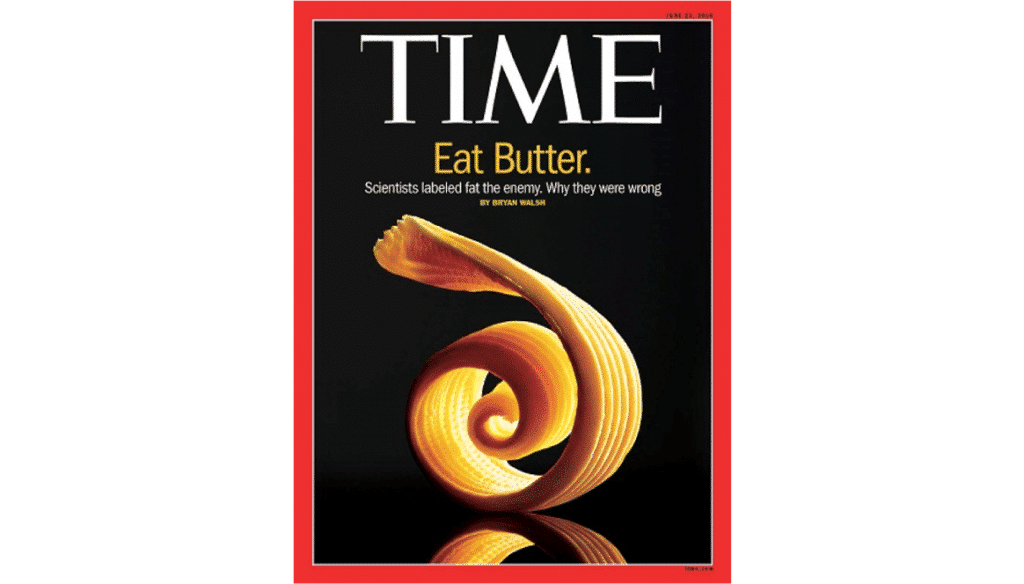
There seems to be a kind of repeat of the battle between the sugar industry and the fat industry in the 1950s and 1960s, when nutritionist Angel Keys believed that animal fat was the culprit behind cardiovascular disease among white men at the age of 50 in the US. As a result, animal fat was replaced by vegetable fat and sugars, and the American population slowly became completely obese. These were the results of poor research with incorrect conclusions. If today’s nutritionists believe that 48+ cheese should be eliminated from our diet because of its low Nutriscore, we once again run the risk of giving other diseases of affluence, such as Alzheimer’s and dementia, more room to grow. This stems from thinking in terms of nutrients rather than looking at food as a whole. The sum is greater than the sum of its parts, meaning that the food matrix is different from the substances being assessed.
The researchers from the Swedish dementia study write the following in their discussion: “…further evidence suggests that full-fat cheese does not increase the amount of lipids in the blood compared to low-fat cheese. In fact, in animal models, 48+ cheese has the greatest benefits for metabolic health, increasing the excretion of fat and energy through faeces. There are also beneficial improvements in the intestinal flora compared to low-fat cheese. In further studies, cheese was associated with a reduced risk of diabetes and high blood pressure, both risk factors for dementia. We suspect that differences in fat content and the nutrients associated with fat (such as vitamin K2), in addition to the different structure of full-fat cheese, explain its protective effect against dementia.”
Regarding the difference in effect between full-fat cheese and butter, the authors write: “Butter consumption is positively associated with the risk of Alzheimer’s disease, but in participants with a better diet, there was an inverse association with the risk of dementia. Butter contains about 80% fat. In the study, people with a better diet generally consumed less fat. Since the literature shows that there is a U-shaped relationship between fat intake and the risk of dementia, butter consumption may still have a protective effect when included in a low-fat diet, while in a high-fat diet it may increase the risk of dementia.”
Conclusion
‘… it was found that a higher intake of full-fat cheese and cream, but not other dairy products, was associated with a lower risk of dementia. The intake of full-fat cheese was associated with a lower risk of Alzheimer’s disease in non-genetically predisposed carriers of the APOE e4 gene.’
Literature
- Du, Y., Borné, Y., Samuelsson, J., Glans, I., Hu, X., Nägga, K., … & Sonestedt, E. (2026). High-and low-fat dairy consumption and long-term risk of dementia: evidence from a 25-year prospective cohort study. Neurology, 106(2), e214343.


